Carbon Fibre: What the Tests Show, and What They Do Not
Published measurements put two bow materials side by side. The data is narrower than either side of the argument usually admits.
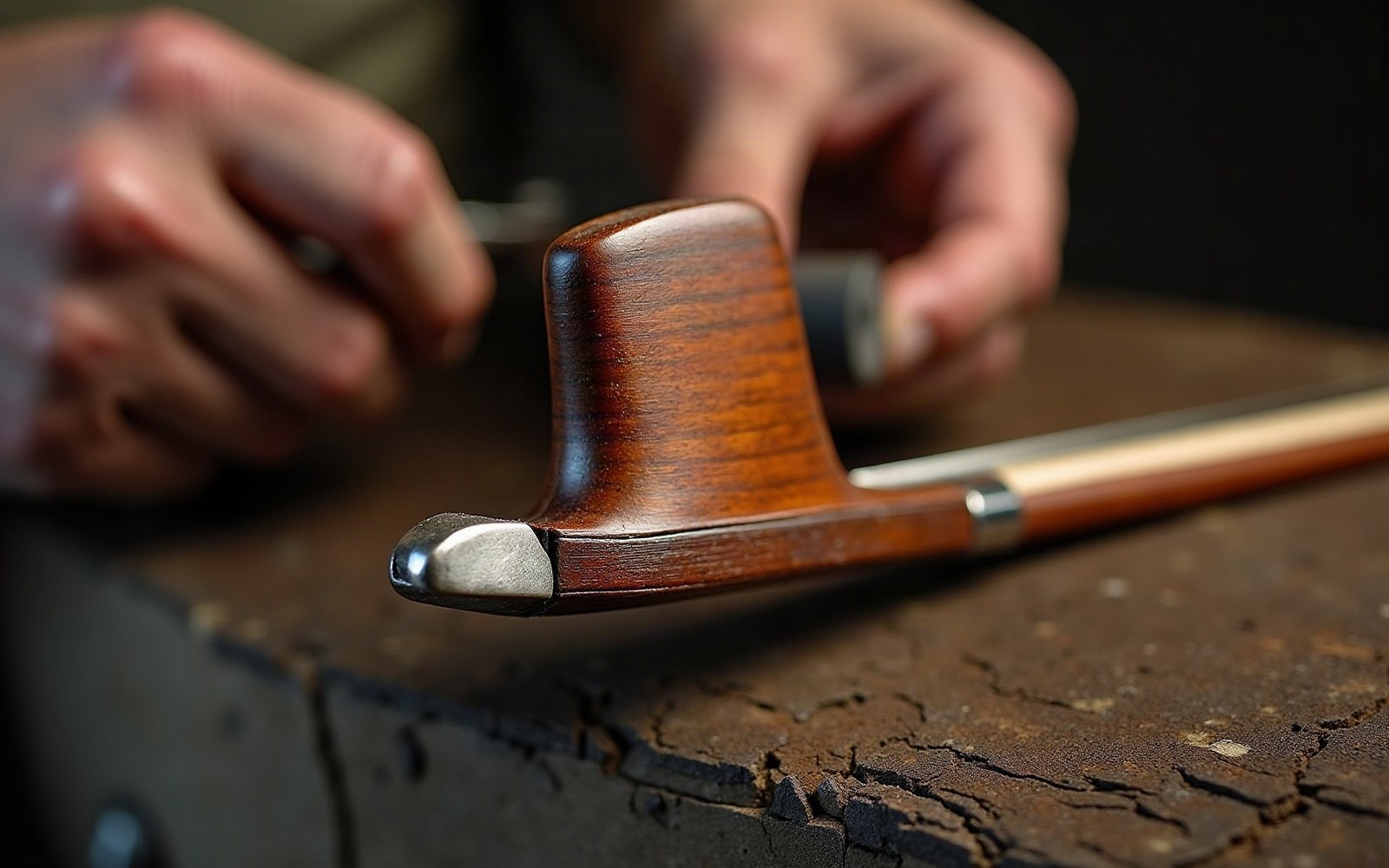
The head plate protects the mortise where the hair is wedged. Ivory was standard here until the trade bans.
Composite sticks copy the gross dimensions. The published tests agree on stiffness and part company on response.
Photo: Zahid Tushar / PexelsWhat the Laboratory Finds
The mechanical case for pernambuco as a bow material rests on two properties working in combination: a high modulus of elasticity — the stiffness that resists bending under load — and a low internal damping coefficient, the material's tendency to dissipate vibrational energy rather than sustain it. Pernambuco's particular balance of these values, combined with its density, is what allows a stick of playing weight to be both responsive and tonally transparent. This is not received wisdom; it has been measured.
The most cited published work on the subject is the comparative study by Romain Viala, Sandie Geoffroy and colleagues, published in the journal Applied Acoustics. Their measurements of pernambuco bow sticks placed the wood's specific modulus — modulus normalised by density — consistently above commercially available carbon-fibre composite sticks tested under the same conditions. The internal damping coefficient of pernambuco was also lower: the wood attenuates vibration less aggressively than the composite material. Both findings hold across multiple specimens in that study and are consistent with earlier material-property surveys carried out at the Physikalisch-Technische Bundesanstalt in Germany.

A dial gauge against a clamped stick: the method behind most of the numbers quoted about bows.
Carbon-fibre composite sticks, however, are not a single material. The term covers a wide range of fibre orientations, resin systems and mandrel geometries, and the mechanical properties of a given stick depend heavily on how it was manufactured. Entry-level sticks and high-end composite sticks made with aerospace-grade unidirectional fibre occupy different parts of the performance envelope. Studies that report carbon fibre as a class tend to sample the mid-range; the top of the composite market may narrow the gap with pernambuco on stiffness, though the damping differential appears to be more persistent.
What the Measurements Do Not Settle
The gap between material properties and playing experience is real and is not bridged by any published study to date. A bow stick is not a uniform beam: it is tapered, cambered — curved inward toward the hair — and acted on by the lateral load of horsehair under tension. Its playing response emerges from the geometry of the whole object as much as from the properties of the material. Two sticks with measurably different moduli can behave similarly in the hand if their taper profiles differ appropriately. This is not a theoretical caveat; it is the practical basis on which makers of composite sticks compensate for the damping differential through geometry.
| Specific modulus | modulus of elasticity divided by density; the property that governs how stiff a stick of a given weight can be; pernambuco scores higher than mid-range carbon fibre composites in published studies |
| Internal damping coefficient | pernambuco's is measurably lower than most tested composite sticks; the difference appears to persist in the high-end composite samples tested |
| Camber | the inward curve of the stick toward the hair; affects playing load distribution independently of material stiffness |
| Modulus of elasticity | absolute stiffness; useful only when normalised by density for cross-material comparison of bow sticks |
The IUCN Red List assessment of Paubrasilia echinata classifies the species as Endangered, and the material-science conversation around carbon fibre is inseparable from that fact. Demand for a substitute has shaped how the research questions get asked, which means the published literature has prioritised identifying whether composite sticks can meet pernambuco's performance threshold — a reasonable question — rather than characterising the full behavioural space of composite materials on their own terms. The two framings produce different conclusions.
What the data cannot currently address is the auditory and haptic experience of playing. No published blind-test study has conclusively demonstrated that trained players reliably distinguish pernambuco from high-end carbon fibre under controlled conditions; the studies that have approached this question are methodologically difficult, and sample sizes have been small. This is not an argument for equivalence. It is a statement about the state of the evidence.
A Fair Reading of Both
The laboratory measurements are clear on one point: pernambuco's combination of specific stiffness and low damping is unusual, and carbon-fibre composites available at the time of the principal published studies did not replicate it. The measurements are less clear — and this is what the polemical framing tends to elide — on whether that replication is necessary for a bow to play well, or whether it is necessary for a player to perceive a difference. Material science sets boundary conditions; it does not determine what happens inside them.
What the tests show is that the two materials are measurably different at the level of the wood and the fibre. What they do not show is how large that difference is at the level of the bow, the player, or the sound.