How a Bow Is Tested: the Published Methods
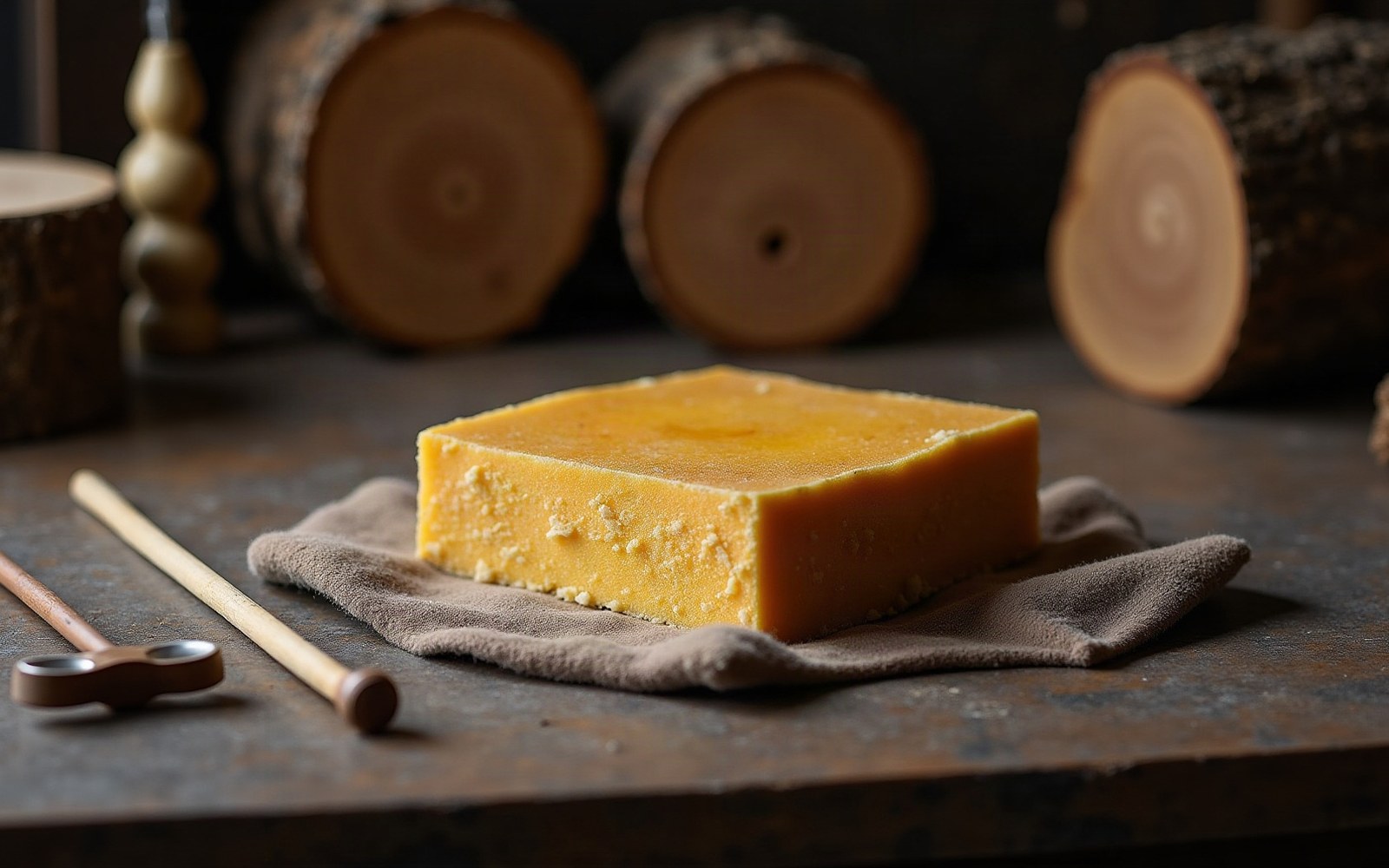
Rosin wears to the width of the hair. The groove is a record of how the bow has been drawn.

A dial gauge against a clamped stick: the method behind most of the numbers quoted about bows.
Instruments in the Laboratory, Not on the Stage
Measuring a bow stick is deceptively straightforward in principle and surprisingly demanding in practice. The two properties that matter most are stiffness — formally, the modulus of elasticity — and the internal damping coefficient, which governs how quickly a vibrating stick returns to silence. Both can be extracted from a single type of experiment: a free-free vibration test, in which the stick is suspended on soft supports at its nodal points, struck lightly at one end, and allowed to ring while a sensor records the decay.
From the resulting signal, researchers extract two numbers. The resonant frequency of the first flexural mode yields the modulus of elasticity once the stick's dimensions and mass are known. The rate at which amplitude decays — expressed as the loss factor — gives the internal damping coefficient. A stiffer stick rings at higher frequency; a stick with higher damping loses amplitude faster. Pernambuco occupies an unusual position in both registers simultaneously: high stiffness and relatively low damping, a combination rare in natural wood and central to why the trade in Paubrasilia echinata became globally significant long before anyone described the physics.
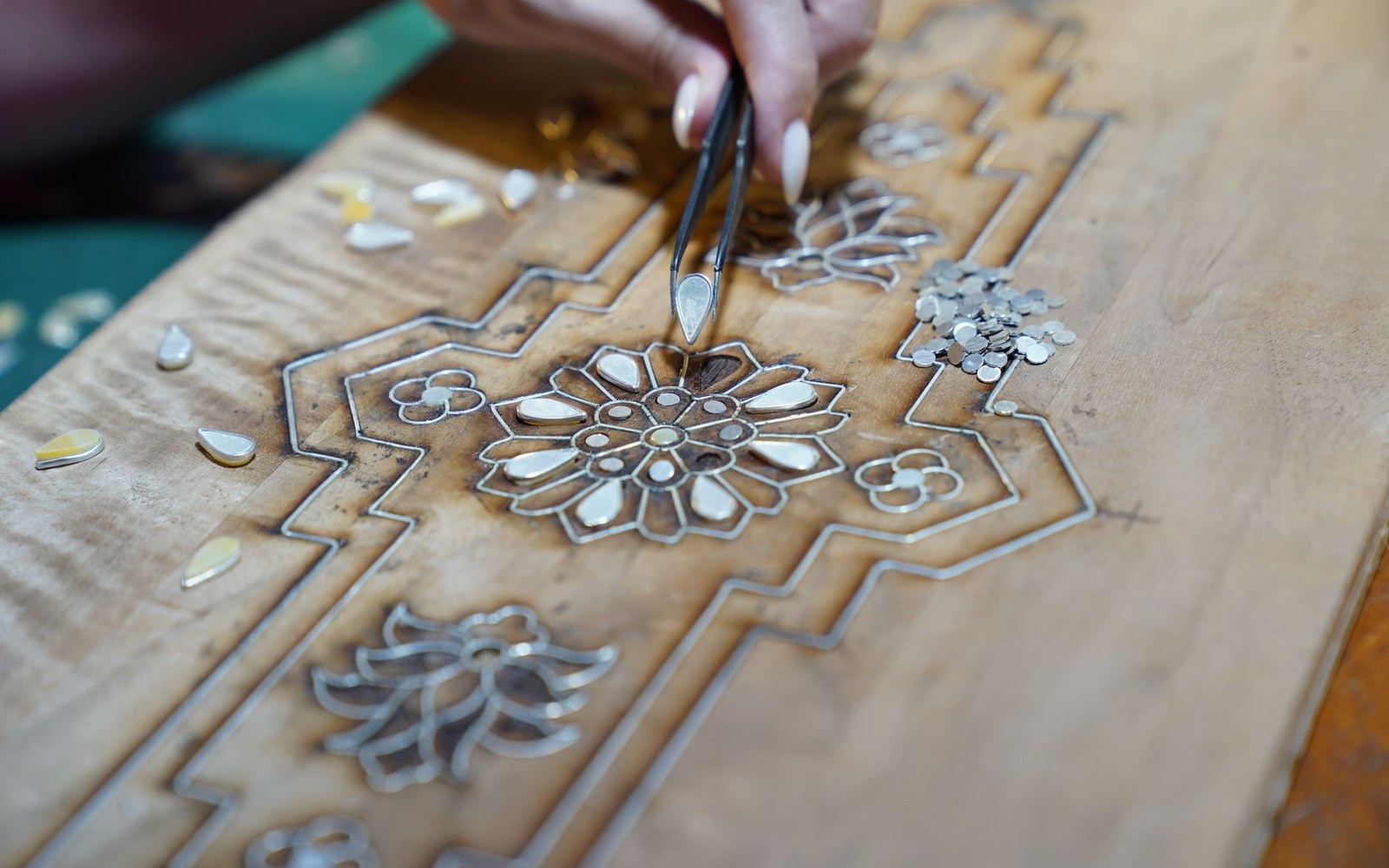
Tortoiseshell inlay on a nineteenth-century frog — a material the trade can no longer legally work.
Photo: Tahir Xəlfəquliyev / PexelsThe most-cited quantitative work comes from studies conducted in France and Brazil during the 2000s and 2010s, several of which appeared in the Journal of the Acoustical Society of America and in proceedings of the International Congress on Acoustics. Researchers at the Laboratoire de Mécanique et d'Acoustique in Marseille, among others, measured sticks drawn from museum collections, professional players and materials-science sample sets, mapping pernambuco against carbon-fibre composites, brazilwood species and a range of alternative timbers. The published comparisons consistently showed pernambuco clustering in a region of the stiffness-damping plane that no tested alternative fully occupied.
Physical setup in these experiments matters more than it might appear. Stick geometry — length, taper, camber — affects the modal frequencies, so careful dimensional measurement precedes every test. Mass distribution is recorded node by node. Humidity and temperature are logged because wood's mechanical properties shift with moisture content; a bow measured at forty percent relative humidity will register differently at sixty. Some protocols use accelerometers; others use laser Doppler vibrometry, which measures surface velocity without contact and avoids adding mass to the system. The IUCN Red List assessment of Paubrasilia echinata cites the combination of commercial rarity and irreplaceable acoustic properties as compounding factors in its Endangered classification — a scientific judgement that the laboratory record quietly underpins.
What no test fully captures is the player's hand. Camber, weight distribution and surface texture all enter the equation the moment a bow leaves the workbench, and those interactions remain beyond any published protocol's reach.
| modulus of elasticity | stiffness of the stick; derived from resonant frequency in free-free vibration tests |
| internal damping coefficient (loss factor) | how quickly the stick stops vibrating; lower is generally preferred in high-quality bow wood |
| free-free vibration test | the standard protocol: stick suspended at nodal points, struck, signal recorded as amplitude decays |
| first flexural mode | the lowest-frequency bending resonance, the one most commonly measured and compared across materials |