Why This Particular Wood Does What No Other Wood Does
Pernambuco wood occupies a narrow window in the space of measurable material properties — and the bow's physics explains exactly why that window matters.
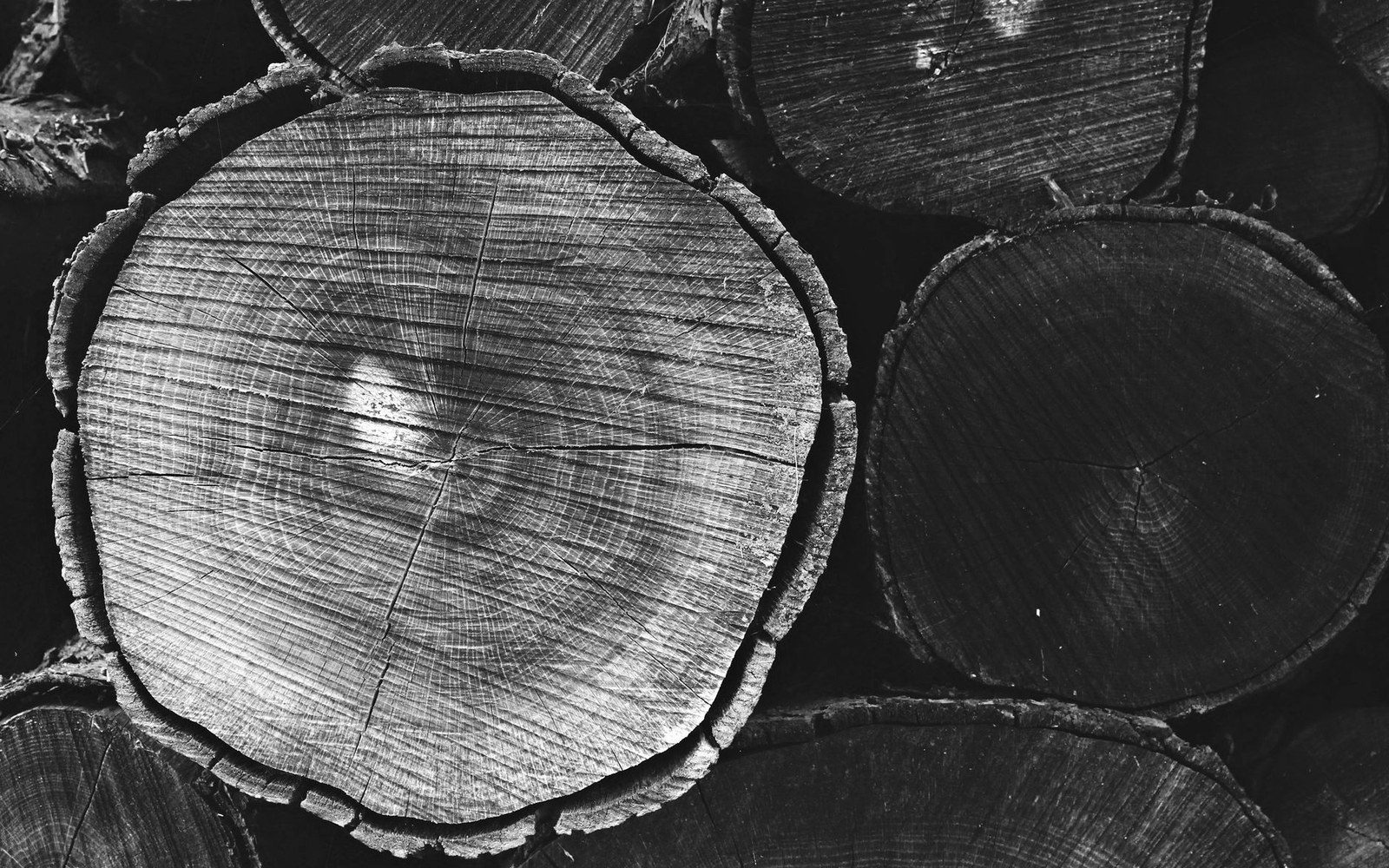
Growth rings and red heartwood. Brazilin, the dye that named the country, comes out of that colour.
Photo: Pixabay / Pexels
Density, modulus and internal damping in one piece of wood. No substitute has matched the combination.
Photo: Malcoln Oliveira / PexelsThe Numbers That Sit at the Intersection
Any bow stick must do two contradictory things simultaneously: it must be stiff enough to resist the lateral loading of the bow hair under playing tension, and it must flex — viscoelastically, transiently — in response to the micro-impulses the hair delivers as it grips and releases a string at frequencies that can exceed several hundred cycles per second. These two demands pull against each other. A material that is very stiff tends to transmit vibration without absorbing it; a material that damps well tends to lack the rigidity to hold its camber under load. Pernambuco sits at an intersection of properties where both demands are met at once, and published measurement confirms that the intersection is genuinely unusual.
The most cited quantitative study of bow-stick materials — Rajan Hanumaiah and colleagues' work published in the Journal of the Acoustical Society of America — measured the specific modulus of elasticity (Young's modulus normalized to density) and the internal damping coefficient (loss tangent, or tan δ) of pernambuco alongside snakewood, brazilwood, carbon-fibre composites and several other candidate materials. Pernambuco's specific modulus in the longitudinal direction was measured in that study at approximately 27–29 GPa·cm³/g, depending on sample and moisture condition — a value substantially higher than that of most tropical hardwoods and comfortably above the range typical of the alternative Caesalpinia-group timbers sometimes sold as brazilwood. Crucially, the internal damping coefficient was simultaneously low: a tan δ in the range of approximately 0.006–0.008, placing pernambuco among the least internally lossy of the woods tested. That combination — high stiffness per unit weight alongside low internal damping — is not common in wood, and it is not replicated by any of the obvious botanical substitutes.
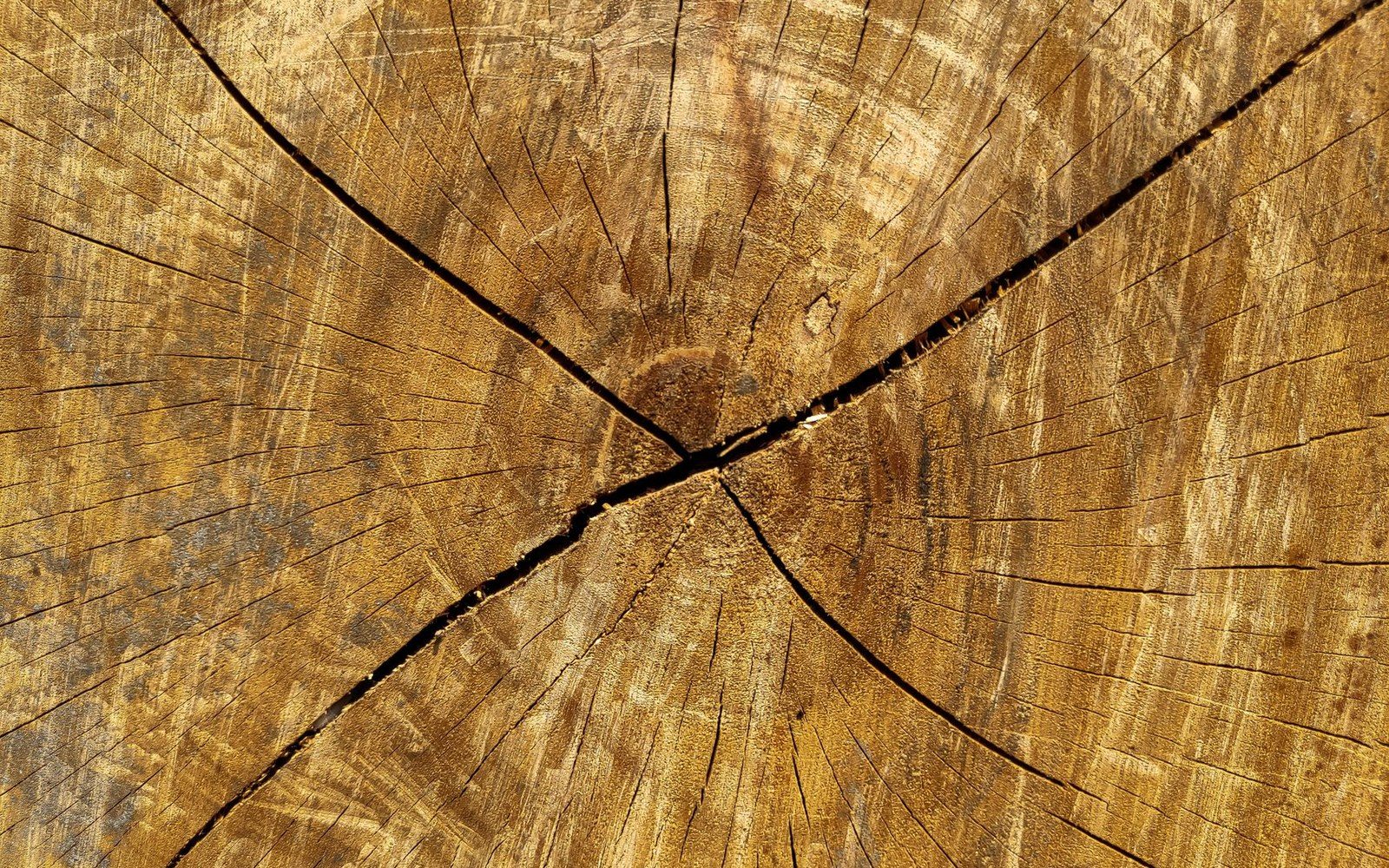
Composite sticks copy the gross dimensions. The published tests agree on stiffness and part company on response.
Photo: Zahid Tushar / PexelsWhat those two numbers mean in practice is the following. A high specific modulus means that a stick of the diameter appropriate to a violin bow (roughly 8 mm at the winding, tapering toward both ends) can be made light enough — typically between 59 and 64 grams for a violin bow stick — while remaining stiff enough to sustain the approximately 90 grams of tension in a fully-tightened ribbon of horsehair without excessive deflection. If the specific modulus were lower, the maker would need either to increase the diameter (adding weight the player's arm must control) or to accept a stick that yields too far under load and loses its working camber. Neither outcome is acceptable in a precision tool.
What Damping Does, and Why Less Is More
The damping coefficient is less intuitive. It might seem that a material absorbing more vibration would produce a smoother, more controlled response — and in some engineering contexts that logic holds. In a bow stick it is largely reversed. The hair–string interface generates a complex, rapidly-varying friction signal; the energy the bow transfers to the string depends on how cleanly those micro-impulses are conducted along the stick and through the hand to the player. Excessive internal damping bleeds that signal. The player loses resolution — the fine-grain textural information that experienced players describe as a bow's "transparency" or "articulation" — because the stick is absorbing energy that should be reaching both the string and the hand as tactile feedback.
| Specific modulus (longitudinal) | approximately 27–29 GPa·cm³/g, depending on sample condition (Hanumaiah et al., JASA) |
| Internal damping coefficient (tan δ) | approximately 0.006–0.008, among the lowest of woods tested in comparative studies |
| Density (seasoned heartwood) | approximately 1.0–1.2 g/cm³ |
| Violin bow stick weight (finished) | typically 59–64 g; the specific modulus allows this without sacrificing rigidity |
Pernambuco's low tan δ means that it conducts vibrational information with high fidelity. The published mechanical tests of bow-stick materials document this clearly: carbon-fibre composites, depending on their layup and resin system, can match or exceed pernambuco's specific modulus, but their damping coefficients are typically higher — in some measured samples, by a factor of two or more. That difference in damping is audible and tactile to skilled players, though it resists easy quantification in listening tests, which tend to be confounded by the weight and balance differences between samples.
Density, the third relevant property, sits at approximately 1.0–1.2 g/cm³ in well-seasoned pernambuco heartwood — dense enough to give the stick inertia and mass stability, but not so dense that a stick of correct diameter becomes unmanageably heavy. Snakewood (Piratinera guianensis), which has been used for bows and which has an even higher specific modulus, is considerably denser; making a snakewood stick to the standard weight range requires reducing diameter to a point that compromises the maker's ability to work the taper and camber with sufficient control. The geometry becomes unforgiving. Pernambuco, being lighter per unit stiffness than snakewood, allows the maker more dimensional freedom.
The Grain That Cooperates With the Tool
Materials-science measurements capture stiffness and damping, but they do not capture workability — and workability matters to the outcome. Pernambuco has a fine, straight, even grain structure that responds predictably to the plane and the scraper. The heartwood, which is the portion used for bows, is dense and homogeneous enough that a maker can work the taper with confidence that the stiffness gradient will follow the geometry. This is not a trivial property. Woods with irregular or highly variable grain — even those with competitive modulus values — produce sticks whose stiffness varies unpredictably along the length, making it impossible to tune the flex profile by visual and tactile inspection alone. Pernambuco allows an experienced maker to read the response of the stick as it approaches its final dimensions, adjusting the cross-section by fractions of a millimetre until the camber and stiffness are balanced. That feedback loop between tool, hand and material is itself part of why the wood suited the craft that François Xavier Tourte consolidated in the 1780s and 1790s — and why no later material has entirely replaced it despite two centuries of alternatives.
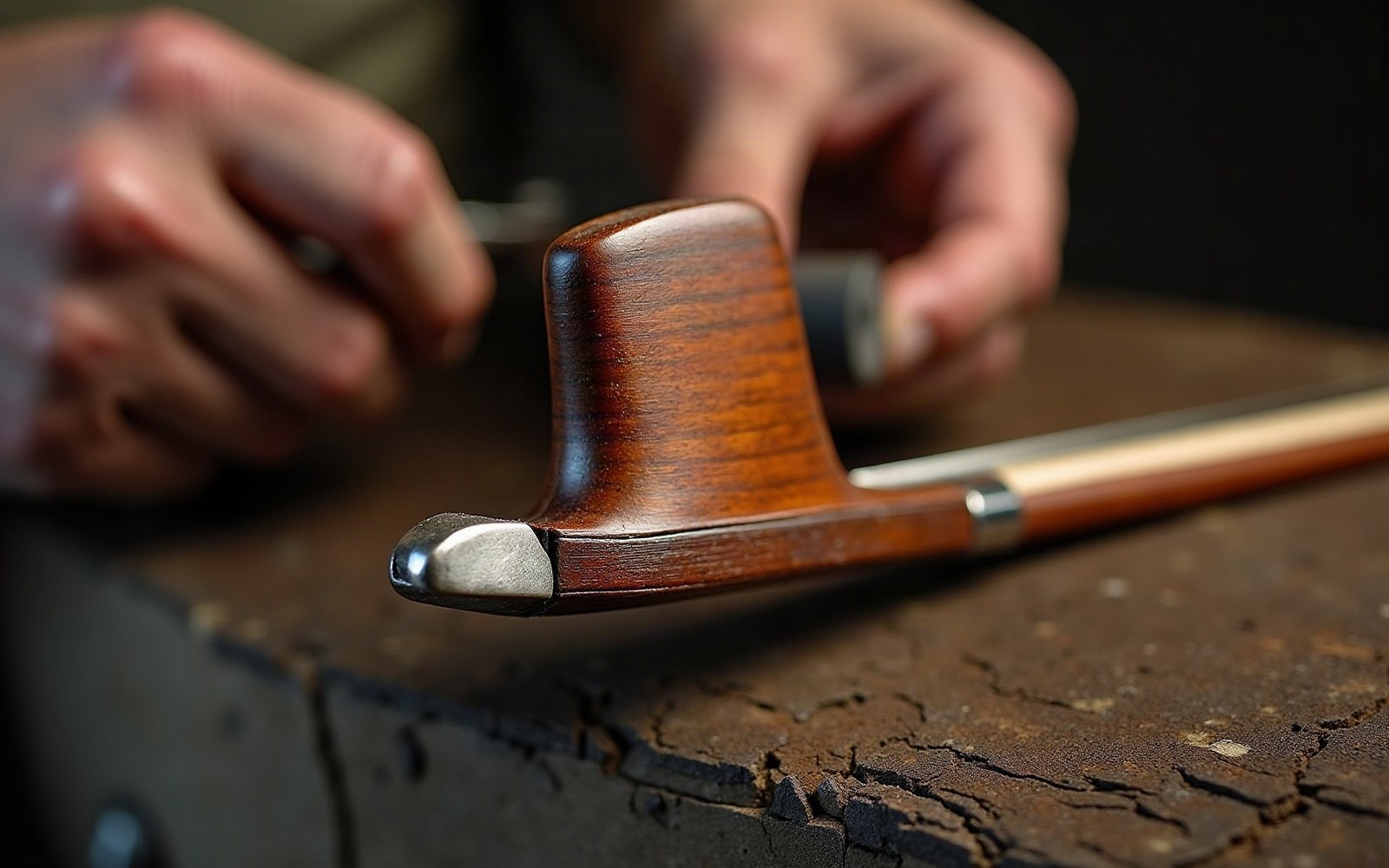
The head plate protects the mortise where the hair is wedged. Ivory was standard here until the trade bans.
The brazilin content of the heartwood — the same organic compound that made pau-brasil commercially valuable to European dyers before the bow trade — may also play a role in the wood's mechanical character, though the causal relationship has not been cleanly established in the published literature. What is documented is that the reddest, most resin-rich heartwood tends to produce the highest-performing sticks, and experienced makers selecting timber have long distinguished the heartwood's colour as a proxy for density and stiffness. Whether brazilin itself contributes to the damping properties or whether it is simply correlated with the cellular structure that produces them remains an open question.
What is not open to question is the convergence of the measurements: high specific modulus, low internal damping, cooperative density and predictable workability occurring together in a single species endemic to a forest that has lost more than eighty-five percent of its original extent, as documented by published assessments of the Mata Atlântica. The physics explains the demand. The ecology explains the crisis. The two facts have been on a collision course since at least 2007, when Paubrasilia echinata was listed on CITES Appendix II, and the numbers in the laboratory record are the clearest statement of why finding a substitute is harder than it looks.
| High specific modulus | allows correct weight at playing diameter; a lower-modulus wood needs more mass or a thicker shaft |
| Low internal damping | preserves tactile and tonal resolution; higher damping absorbs the micro-impulse signal that players read as articulation |
| Density in the working range | gives mass stability without forcing a diameter reduction that compromises the taper geometry |