Tourte's Proportions, and Why They Stopped Moving in 1785
The violin bow's defining geometry was settled by one man in one Parisian workshop — but the workshop itself is harder to find than the legend suggests.
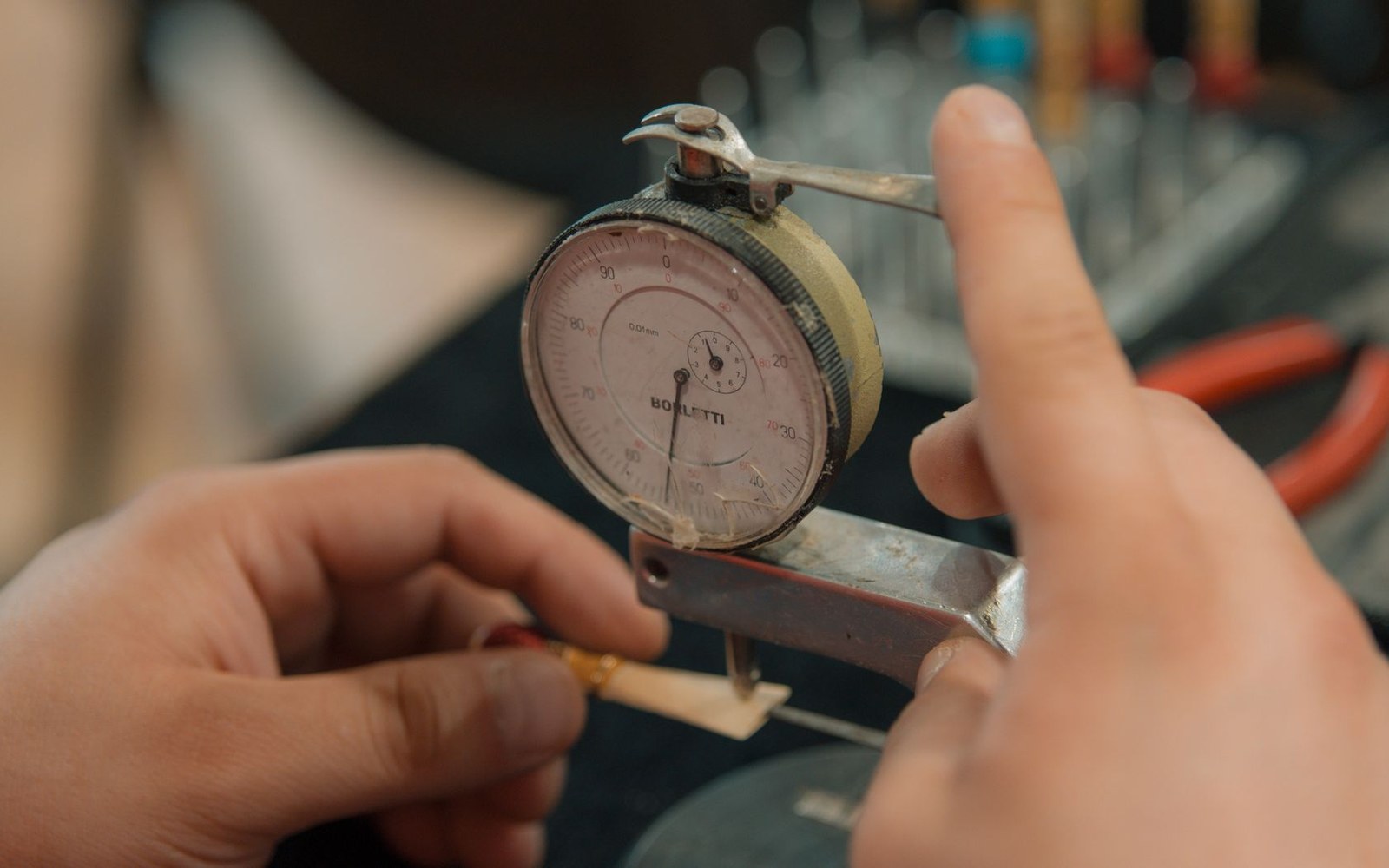
Thumb planes, calipers, gauge. Almost all of bow making is removing material that cannot be put back.
Photo: Sandin Redzo / Pexels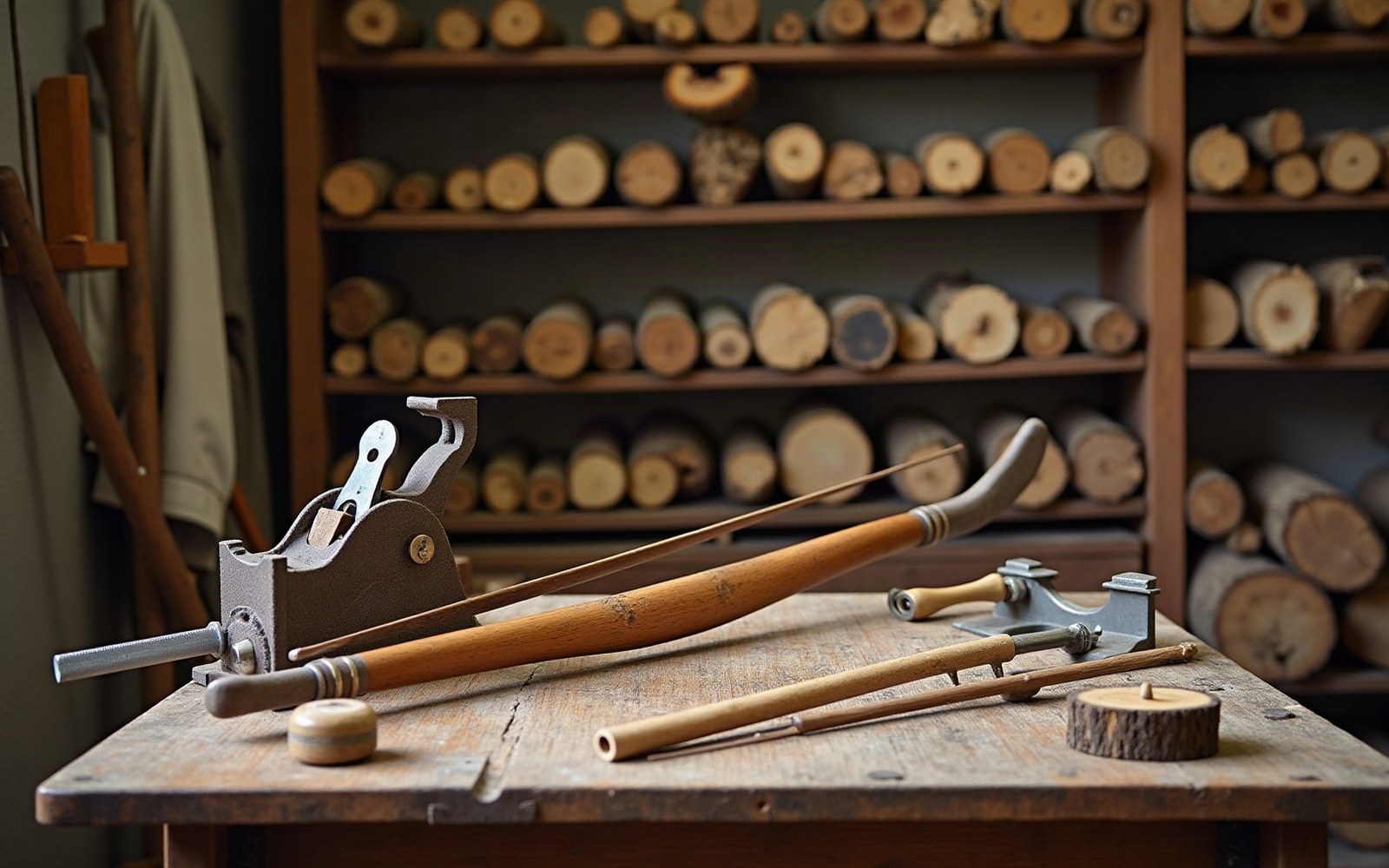
A watchmaker's son who worked by trial: lengths, weights and woods tested by players who could say what responded.
A Bow Maker's Son Who Trained as a Watchmaker
François Xavier Tourte was born in Paris around 1747, the son of a bow maker, and he trained first as a watchmaker — a detail that survives in several nineteenth-century accounts and that craftsmen have always found significant. The precision instilled by clock mechanisms, the tolerance for small, consequential differences, the habit of fitting parts to functions: these formed him before he returned to his father's trade, probably in the early 1770s. His brother Nicolas Pierre Tourte was also a bow maker of note, active somewhat earlier, and the two have been conflated in some older literature. Separating them is part of the editorial work the surviving record demands.
What Tourte the younger achieved — and appears to have settled on by roughly 1785 — was a set of proportions and a method of working pernambuco that produced a bow whose mechanical behaviour matched the evolving demands of the concert platform so exactly that no subsequent maker has found a reason to overturn the fundamentals. The stick's overall sounding length, the graduation of its taper from frog to tip, the placement and geometry of the head, the weight distribution that shifted the balance point closer to the hand: each of these was the result of empirical experiment conducted under conditions no document fully illuminates. The numbers themselves — approximately 74 to 75 centimetres of overall length, the finished weight in the region of 60 grams for a violin bow — are quoted in every serious study, but the dates and process by which Tourte arrived at them are reconstructed from the bows rather than from workshop notes, because no workshop notes survive.
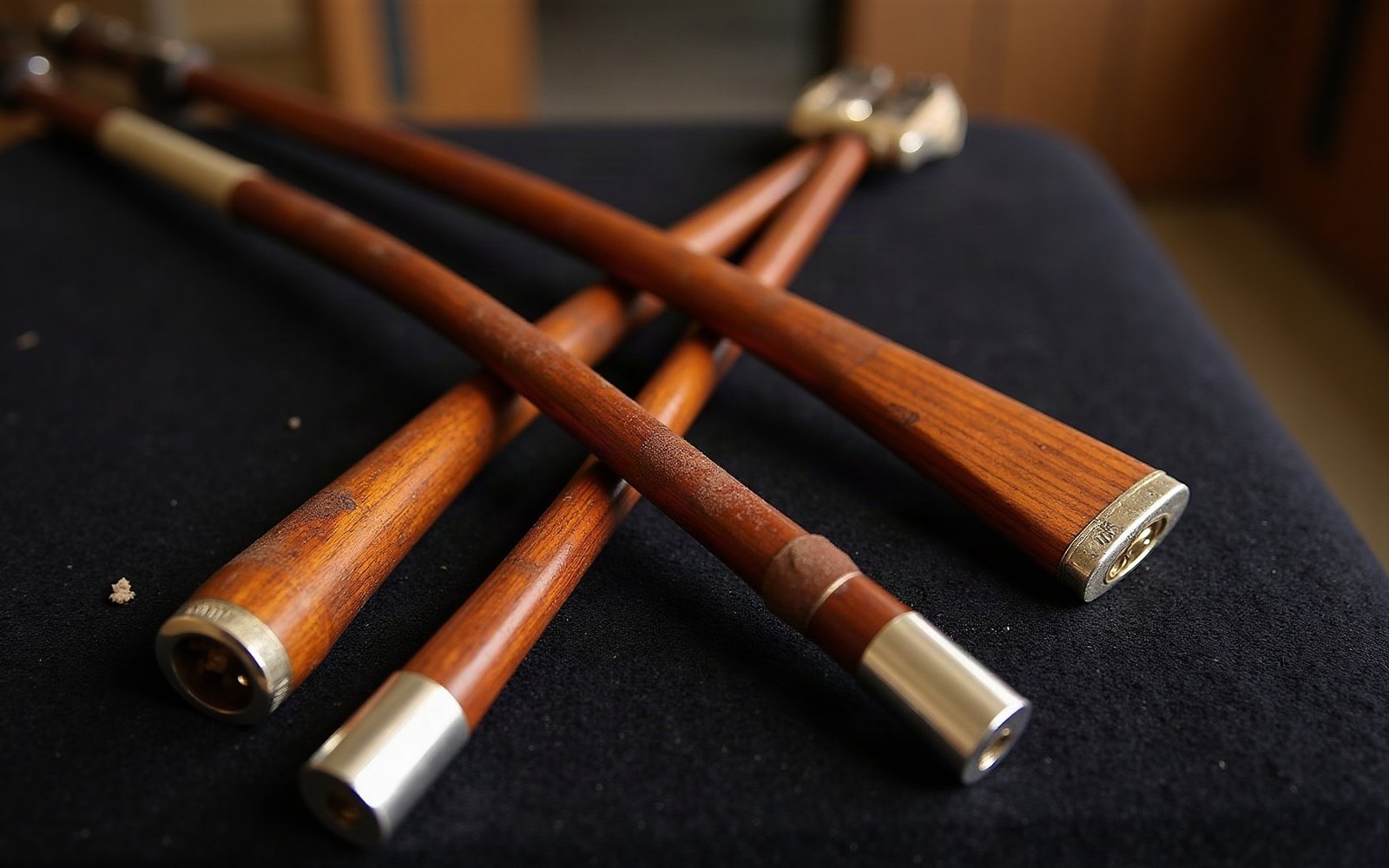
London and Mirecourt in the same decade. Attribution here rests on heads, frogs and the auction record.
The choice of Paubrasilia echinata — the species still known by its former binomial Caesalpinia echinata in older literature, reclassified in 2016 — was itself not accidental. Pernambuco heartwood combines a high modulus of elasticity with a low internal damping coefficient and a density that allows the necessary mass to be held in a slender stick. Tourte did not discover the wood; it had been known in European trade for two centuries as a dye source before bow makers began working it. What he discovered, by accumulating samples and working them, was how to read and exploit its grain for the specific purpose of archery-derived camber — the slight inward curve bent into the stick toward the hair — under controlled heat. The camber he applied, held once the wood cooled, gave the stick its tension and its recovery. No earlier bow maker had achieved the combination with this degree of consistency.
What the Surviving Bows Actually Show
Instruments attributed to Tourte appear in a handful of named institutional collections. The Cité de la Musique in Paris holds examples within its historical string instrument holdings. The Ashmolean Museum in Oxford, through the Hill Collection, contains bows from the period. W. E. Hill & Sons, the London dealers and makers who were themselves the most authoritative early chroniclers of bow history, attributed specific examples in their catalogues and in the 1909 monograph Violin-Making as It Was and Is and its companion bow literature — texts that remain the foundation of any serious bibliographic engagement with the subject. The Hills' attributions, however, were made without the benefit of dendrochronology, spectroscopic analysis or any of the materials-science tools later researchers have applied, and later scholarship has revised some of their assignments. The lesson is not that Hill & Sons were careless; it is that attribution at this distance requires physical evidence that early cataloguers did not possess.
- c. 1747François Xavier Tourte born in Paris
- Early 1770sbelieved to have returned to bow making after watchmaker training
- c. 1785proportions and taper established in their settled form (reconstructed from surviving bows)
- 1835Tourte dies in Paris
- 1909Hill monograph literature establishes much of the canonical attribution record
- 2009Journal of the Acoustical Society of America study documents pernambuco's mechanical singularity
- 2016Paubrasilia echinata adopted as revised binomial (reclassified from Caesalpinia echinata)
What the bows themselves show, across the examples subjected to modern examination, is remarkable consistency. The octagonal stick — planed to eight flat faces — appears on some Tourte examples, the round cross-section on others; the choice was not a marker of period but of function or commission. The frog, with its ferrule spreading the horsehair ribbon to uniform width, its eyelet engaging the screw, shows the Tourte workshop's refinement of components that had existed in cruder forms in pre-Tourte bows but had not previously been unified into a system with this mechanical completeness. The mechanical integration of frog, ferrule and eyelet into a smoothly adjustable unit is as much Tourte's contribution as any dimension he fixed.
The head plate — the thin protective inlay at the bow's tip — appears in ivory on the bows attributable to Tourte's active period, a material subsequently subject to CITES restriction. The sticks themselves, where they have been tested, show the density and stiffness gradients that materials scientists have since identified as the properties that made pernambuco irreplaceable for the purpose. A 2009 study published in the Journal of the Acoustical Society of America measuring the mechanical properties of pernambuco versus alternative materials placed it in a performance space that no tested substitute occupied simultaneously — high stiffness, appropriate density, low internal damping — a combination Tourte found empirically that physics has since explained.
The Legend and What Lies Behind It
The legend holds that Tourte worked alone, in near-monastic isolation, refusing to accept commissions from dealers and selling directly to the players who sought him out. Giovanni Battista Viotti, the violinist whose playing shaped the demands the modern bow needed to meet, is repeatedly associated with Tourte in the historical literature, the implication being that the two worked in a kind of creative dialogue. Whether that dialogue was sustained, occasional or largely retrospective is not established by documents. Viotti was certainly in Paris in the relevant period; he was certainly a demanding and influential musician; the rest is inference.
The rail above the bench: everything the maker reaches for without looking away from the work.
Photo: cottonbro studio / PexelsWhat is documented is Tourte's address in Paris — sources place him on the Île de la Cité and later on the Île Saint-Louis — and the commercial reality that his bows commanded premiums over other makers' work within his own lifetime, a premium that the Hills' records and subsequent Tarisio and Sotheby's auction results have only amplified. The premium attached not to provenance alone but to performance: players and collectors acquiring a Tourte bow were, at every point in the instrument's post-workshop history, paying for dimensions and material properties that produced measurable results under the bow arm.
Tourte worked until late in his life — his active period appears to have extended well into the nineteenth century, and he died in Paris in 1835 — but the dated consensus, reconstructed from the bows themselves, is that the proportions were essentially established by the mid-1780s. Everything thereafter was refinement within a settled architecture: adjustments to individual sticks, responses to particular woods, the accumulated skill of a maker who had spent decades reading a grain that the Atlantic Forest produced in finite and diminishing quantity. The craft tradition he established fed directly into the Mirecourt workshops of the next generation and then to makers across Europe. What he settled in that Parisian decade was not a fashion but a solution to a physical problem, and the IUCN's endangered listing for Paubrasilia echinata is, among other things, a measure of how much of the forest his successors eventually needed to sustain it.
| camber | the slight inward curve bent into the stick toward the hair, producing tension and playing response |
| modulus of elasticity | stiffness measurement governing how the stick flexes under load; high in pernambuco |
| internal damping coefficient | a material's absorption of vibrational energy; low in pernambuco, preserving tone |
| octagonal stick | stick planed to eight flat faces, as opposed to round cross-section; both forms appear in Tourte attributions |
| head plate | protective inlay at the bow tip; ivory on Tourte-period bows, now restricted under CITES |