Dominique Peccatte and the School That Carried His Name
One maker's hand reshapes the standard, and a generation of workshops in Mirecourt spends decades proving it.
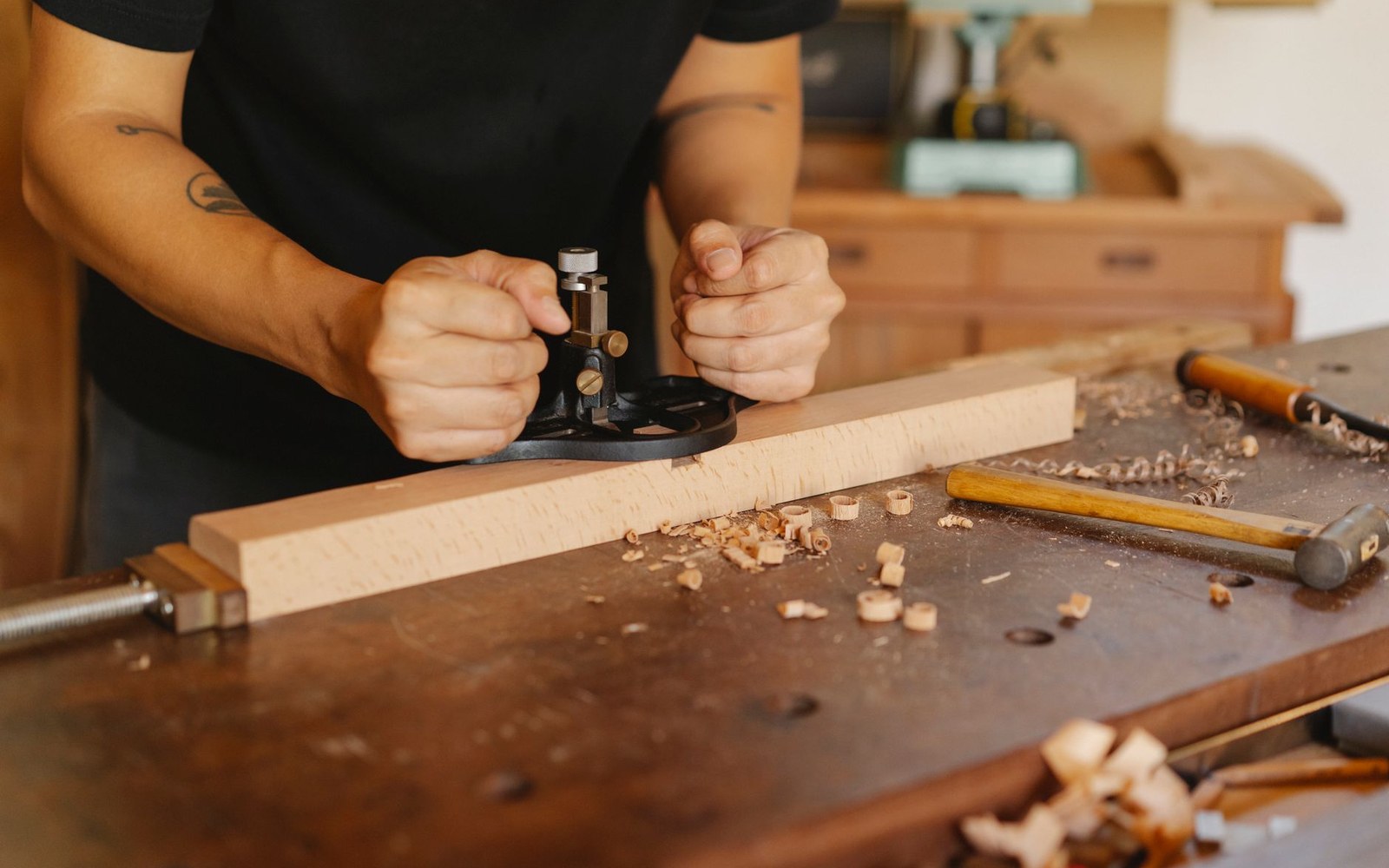
A billet is planed down by hand before a single facet is cut. What the maker is reading is grain direction, not thickness.
Photo: Ono Kosuki / Pexels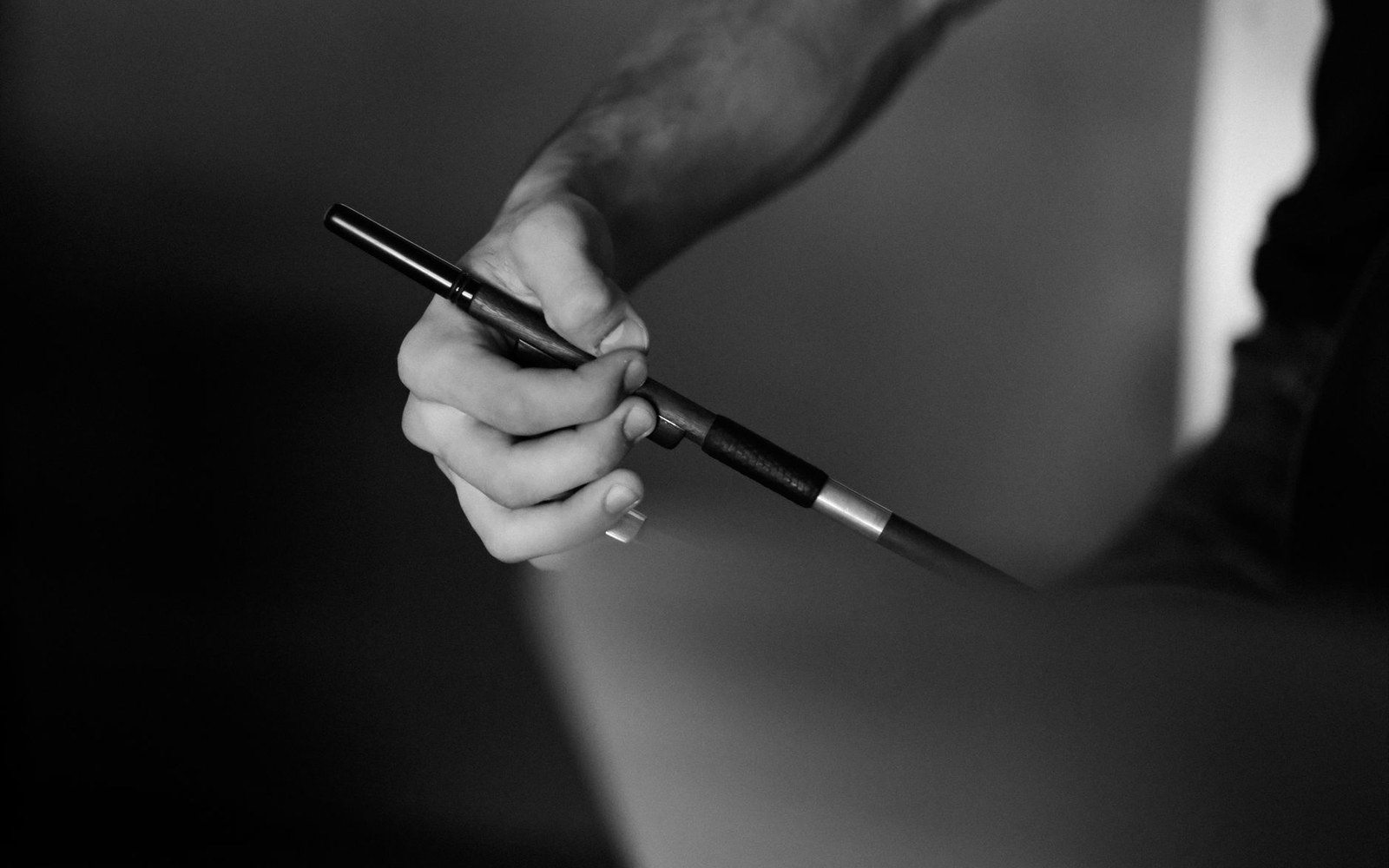
The broad head and muscular taper a school formed around, held inside Tourte's length and weight.
Photo: Alina Chernii / PexelsThe Hand Behind the School
Dominique Peccatte was born in Mirecourt in 1810 and died there in 1874, and the arc between those dates encompasses one of the most consequential single careers in the history of the French bow. He trained initially in Paris under François Xavier Tourte, absorbing the proportions and taper logic that Tourte had codified a generation earlier, then worked for a period in the Paris atelier of Jean-Pierre Marie Persoit before establishing an independent reputation that would outlast his own working life. What distinguishes Peccatte from his contemporaries is not innovation for its own sake but an intensification of what already existed: his sticks carry a particular combination of arch, weight distribution and tonal response that other makers immediately recognised as a target worth pursuing.
The material Peccatte worked was Paubrasilia echinata — pernambuco — at a historical moment when Brazilian timber merchants still supplied Mirecourt workshops with regularity. The wood's density and modulus of elasticity allowed a skilled maker to cut a stick that flexes predictably under the playing load while returning energy cleanly to the string. Peccatte's selection from available timber was, by the evidence of surviving examples, exceptionally disciplined. The Tarisio auction catalogue has documented multiple Peccatte violin bows across successive sales, and the detailed condition and measurement notes in those records allow some cross-referencing of weight and camber that is difficult to achieve by examining single institutional holdings alone.
What the Workshops Learned
The phrase "Peccatte school" covers three overlapping realities: makers who worked directly in his shop, makers who studied his output and adapted it, and later Mirecourt production stamped or attributed loosely to his influence. Among the first group, François Nicolas Voirin is the figure who complicates the neat genealogy most productively. Voirin worked in Jean-Baptiste Vuillaume's workshop before establishing his own practice, and the relationship between their mature styles — shared in some structural proportions, divergent in head geometry and graduation — has been a persistent subject in attribution scholarship. The transition from Peccatte's heavier, more powerful aesthetic toward Voirin's lighter refinement is one of the defining movements in nineteenth-century French bowmaking, as documented in the collections of the Cité de la Musique in Paris, which holds examples of both makers' work available to researchers.
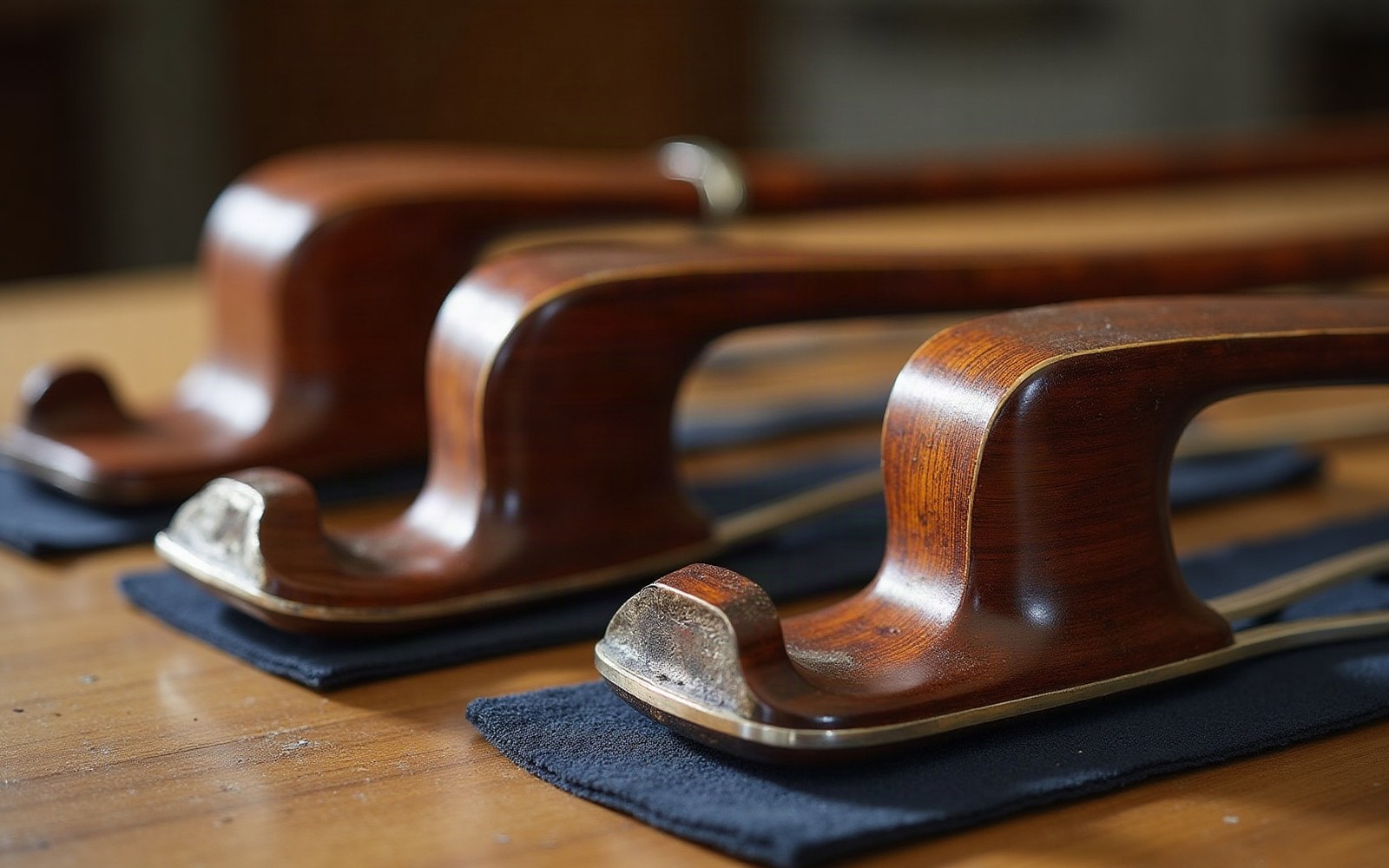
Voirin's slender line, then Sartory's. Both shifts show in the head and the frog, not the dimensions.
Beyond Voirin, the school disperses into a less individualised but equally consequential tier: workshop sticks branded with variants of the Peccatte name, sticks bearing the marks of Mirecourt trade houses that consciously modelled their production on his output, and a class of unstamped bows that auction specialists and private scholars continue to argue over. The criteria most consistently applied in attribution — head outline, chamfer cut, the angle at which the mortise sits within the frog, the profile of the stick through its lower third — derive directly from study of securely attributed Peccatte examples. Tarisio's published lot notes for Peccatte-attributed bows at major sales have become a de facto public record of what these criteria look like when applied by specialists with access to comparative material.
The Problem of the Name
The school's legacy also created an attribution problem that was never fully resolved in Peccatte's lifetime and remains active in the auction room. Because his work was immediately recognised as a benchmark, the commercial incentive to stamp or attribute bows to his name was substantial. Sotheby's and Tarisio sale catalogues both carry periodic entries distinguishing between bows attributed to Peccatte, bows from his circle, and bows in his manner — distinctions that affect price materially and that rest on physical evidence rather than documentation, since workshop records from mid-nineteenth-century Mirecourt are largely absent. The IUCN's assessment of Paubrasilia echinata as Endangered on its Red List adds a layer of contemporary complexity: the forest that supplied this wood is now reduced to roughly eleven to twelve percent of its original extent, and the provenance and material composition of historic bows carries weight that is simultaneously historical, legal and ecological.
What Peccatte left is finally neither a curriculum nor a house style but a measurable effect on what French bowmaking thought was possible. The school that formed around him was not an institution; it was a shared recognition that one maker had moved the standard, and that the only response was to spend a career in its vicinity.
- 1810Dominique Peccatte born in Mirecourt
- Active in Paris, working with Persoit before independent practice
- Mid-nineteenth centuryMirecourt workshops adapt Peccatte's output as a production model
- 1874Peccatte dies in Mirecourt
- Ongoingattribution debates continue in major auction sales (Tarisio, Sotheby's)