Voirin to Sartory: What Shifted at the End of the Nineteenth Century
Two makers, forty years apart, and a set of changes most players hold in their hands without knowing it.
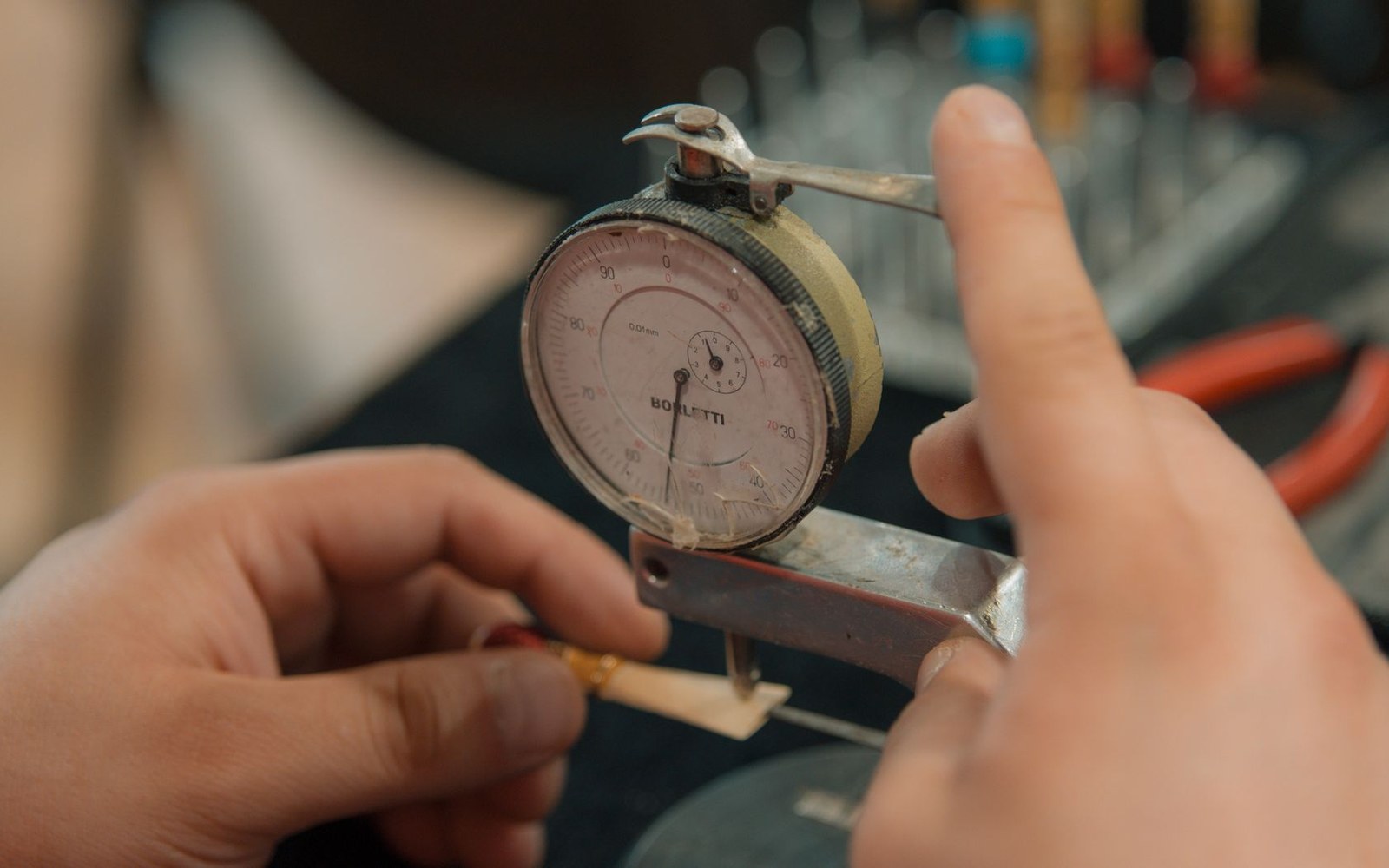
Thumb planes, calipers, gauge. Almost all of bow making is removing material that cannot be put back.
Photo: Sandin Redzo / Pexels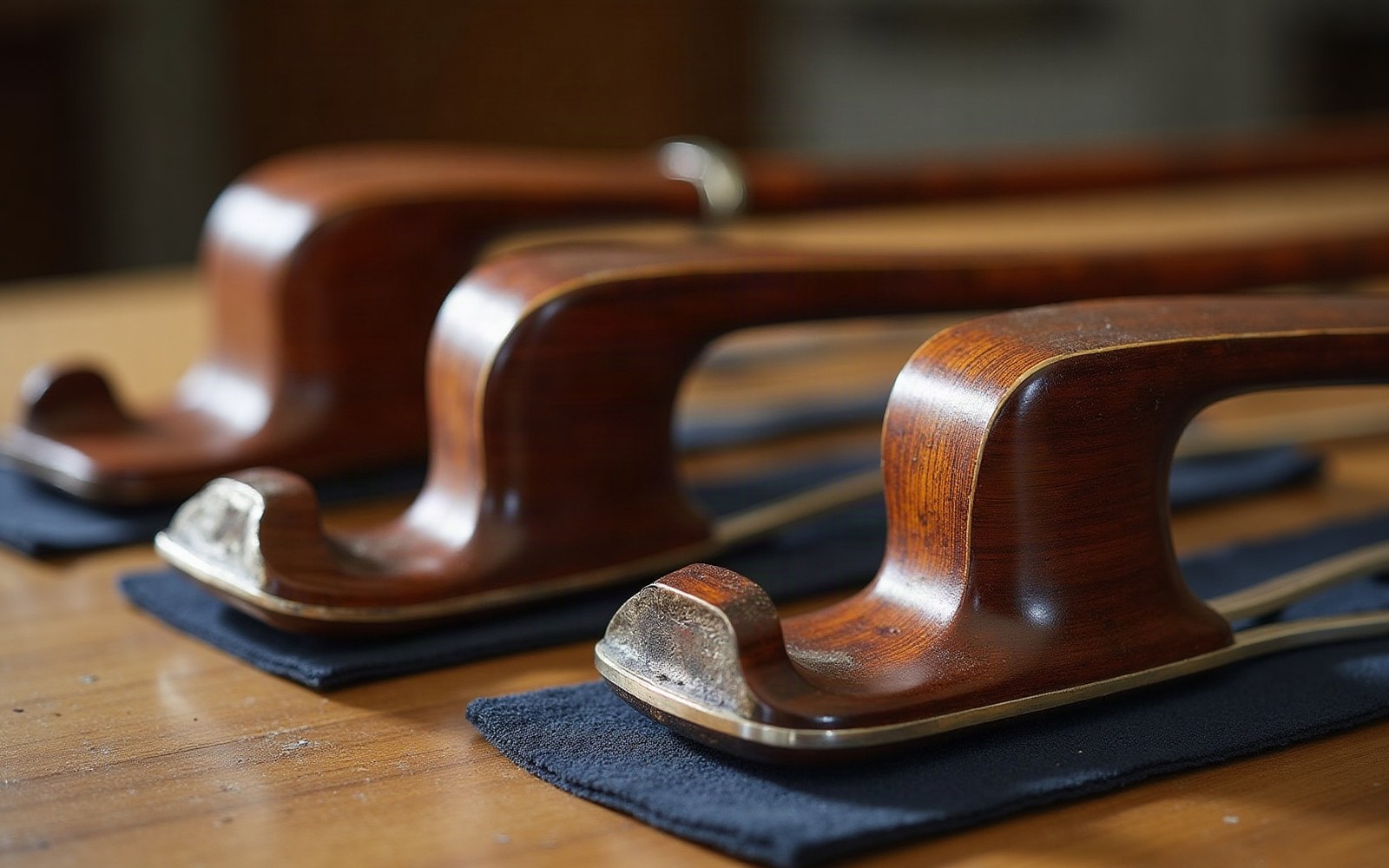
Voirin's slender line, then Sartory's. Both shifts show in the head and the frog, not the dimensions.
A Refinement, Then a Redefinition
François Nicolas Voirin worked in Paris from around 1860 until his death in 1885, and the bows he produced in that quarter-century are the clearest demonstration that the Tourte model was not fixed. It was a platform. Tourte had settled the fundamental geometry — stick length, camber arc, the relationship between tip mass and frog mass — but the details of the head, the transition from stick to head, and the precise distribution of weight along the shaft remained open questions that each generation of Paris makers answered differently. Voirin's answer was elegance through attenuation: narrower heads than his immediate predecessors, with a distinctly elongated chamfer line that drew the eye forward and reduced apparent mass at the tip without meaningfully compromising structural integrity. The throat of the head — the concave cut on the underside — became more pronounced in his hands, a change that is visible in surviving examples held at the Cité de la Musique and documented in several dated Tarisio auction catalogues. That deeper throat lightened the tip section and shifted the bow's balance point marginally toward the hand, making the upper half feel more responsive under the bow arm.
Voirin also refined the octagonal stick's geometry relative to the round, preferring the round section for violin bows with a consistency that set him apart from contemporaries who mixed both freely. His mountings — the frog, ferrule and adjuster — were made to close tolerances, with a neatness of fit that later makers cited as a benchmark. The silver-mounted examples show a ferrule profile that is marginally wider than Peccatte's, spreading the hair ribbon more evenly across the tip's full width. These are small changes, none of them revolutionary in isolation. Assembled in a single instrument over a working life of twenty-five years, they constitute a distinct voice.
What Sartory Pushed Further
Eugène Sartory trained in the late nineteenth century and became the dominant figure in Parisian bow-making in the early twentieth, working into the 1940s. Where Voirin refined, Sartory consolidated — and then, systematically, intensified. His heads are broader at the face than Voirin's and sit on a slightly heavier tip section; the overall silhouette reads as more robust, even monumental by comparison. This was not regression. It reflected a deliberate recalibration in response to what professional soloists in expanding concert halls were demanding: bows that projected more force into the string without losing the articulation that lighter tips allowed.
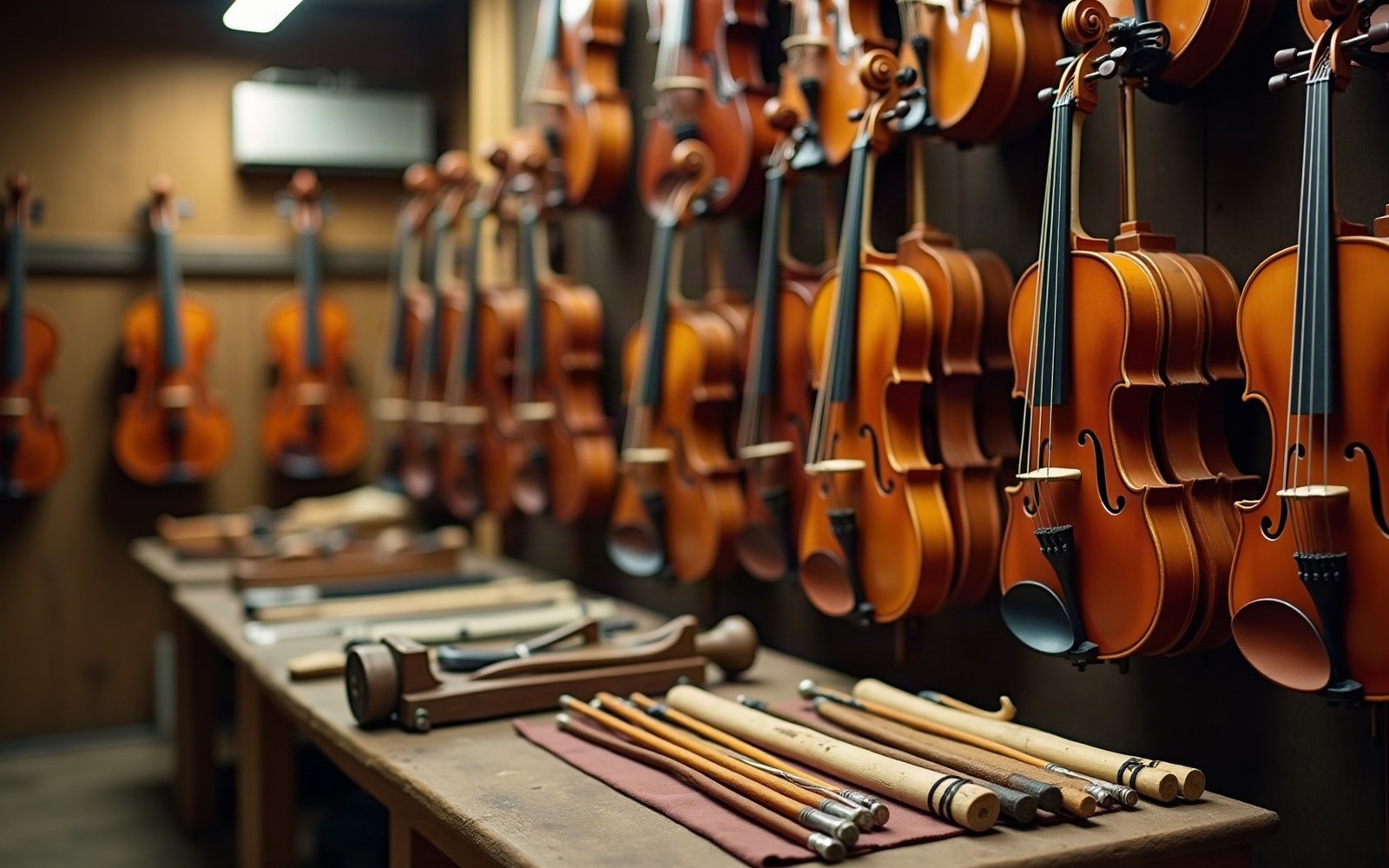
A workshop bow carries a house stamp rather than a hand. Hill and Pfretzschner both worked at scale.
The weight distribution Sartory arrived at — his violin bows typically measuring around 60–62 grams at the finished stick, a figure consistent with published auction descriptions of verified examples — placed slightly more mass in the upper third of the stick than Voirin's comparable instruments. The practical consequence is a bow that presses the string with greater authority at the tip, useful for sustained fortissimo playing and for the broad, heavy strokes that late Romantic orchestral writing frequently demands. The camber, too, is characteristically firmer in Sartory's surviving work: less yielding under load, more resistant to collapse at full-bow pressure.
Mounting choices marked the transition as clearly as geometry. Sartory worked extensively in gold, and his gold-mounted bows represent a move toward the premium market that Voirin, dying in 1885 before the full emergence of that market, had only begun to serve. The gold ferrule and adjuster added marginal mass at the frog end, counterbalancing the heavier tip and helping to maintain the balance point Sartory favoured. These were not decorative decisions alone: each choice in mounting material has a mechanical consequence, however small, on where the bow sits in the hand.
The shift from Voirin to Sartory is, in the end, a shift from refinement to reconfiguration — a re-weighting of every variable toward a more powerful, more deliberate instrument. Most players cannot articulate it. They feel it in the arm after a long rehearsal, in the extra effort the Voirin bow demands of a tired shoulder, in the effortlessness with which a Sartory tip finds the string. The craft record, at least, is clear enough to be read.
- c. 1860Voirin begins independent work in Paris
- 1885Voirin dies; his productive period spans roughly twenty-five years
- Late 1880s–1890sSartory's formative training period in Paris
- Early twentieth century to c. 1946Sartory's active working life as a leading Paris maker